See more of Clint's Photographs

22 February, 2013

Bison Day in Yellowstone

This past fall, we discovered a new entrance to Yellowstone National Park. It starts about 8 miles north of Gardiner, where the Roosevelt Archway resides. You cross the Yellowstone River and head south on a dirt road that travels through acreage that is now part of the park. 

Soon after we crossed the river on this trip, we saw a lot of bison, in areas that we were not accustomed to seeing. These bison had drifted out of the regular park and were looking for better place to eat in the winter. There were 2 reasons for this activity. The vegetation in the park, this time of the year, is not only snow covered but not very rich in nutrients. In addition, there is currently an excess number of bison in the park based on the vegetation and the total population of all species of animals.
We were aware that the hunting season for the bison had been extended in hopes of reducing the population to a number that is inline with the proper sharing of vegetation. We had not traveled far when we started observing swarms of ravens or crows as you might call them. These 2 trees had about 75% fewer birds in them when I took this photograph, as we had frightened them as we stopped to take the picture.
Anyone living in this part of the country knows that when you see swarms of ravens, there is a carcass nearby. What had attracted the birds to this area was the remains of bisons that the hunters were not interested in taking with them, after they killed their target. As we left this area and before we went through the archway, we passed the Gardiner School and football field. Guess what we saw, more bison and pile after pile of bison manure, the remains of them grazing on the grass from the football field.
Then we learned something else. At this time of the year, there is no detention for the students who get in trouble with the school and/or teachers. The problem students are offered a bag, a scoop, and are pointed to the football field to start cleaning up the manure. I guessed this was enough of a deterrent, that the student body was on it's best behavior, and the manure was piling up.

We were soon in the park and we saw a lot more bison. Soon after we headed east from Mammoth Hot Springs we started to see them on the road, and they were not interested in letting us pass. We lost at least an hour of travel time as we headed east and then returned. 

The scenery changed as we spotted a coyote who had just crossed the road and was heading into the trees. There were other coyotes during the day but we needed binoculars to see them.
And it just wasn't just herds of bison heading down the road, it was also bison who preferred the road to the deep snow, and when they got good footing, they decided to do other things as these two were fighting and held us up until they were tired. We didn't dare try to pass them as we might had been rammed by one or both of them.
We had our fill of bison by this time. So we came along a herd of pronghorn, you may call them antelope and this one seemed to be posing for us. Thank you Mr. Pronghorn, we needed a break in the scenery.
But it wasn't over yet, as we were traveling through Lamar Valley, look what was napping in the middle of the road. Not only was there no snow on the road, but by now the sun had warmed it up to the point that it was a comfortable rest.
More of the same until we were heading north of Gardiner towards the bridge we had crossed about 8 hours earlier. As we peered down to the Yellowstone River, we saw this marvelous bird. What a way to end another wonderful trip to the park.
You are probably asking, were there any elk during your visit. There were quite a few but none of them  triggered my photograph sense. We did not see any wolves at all.

Tune in next month and we'll share our next trip through the park with you.

25 January, 2013

What's different a month later

I researched the wildlife on my favorite Yellowstone web site, forums.yellowstone.net, and came to the conclusion that we needed an early breakfast at Chico and to start our visit early. This was a great idea as we saw a lot more wild life on this trip than on our last one. The elk were much more prevalent and this youngster, standing in the snow was a favorite image. The big boys must have been hiding, but there were a lot like this one.
Although there were a lot of bison before, we got more interesting glimpses of them as they were closer to the road. We thought this one was trying to hide from us but how can a big guy like this find shelter behind a tree.
Soon after we left Mammoth, we rounded a curve in the road and saw a coyote enjoying breakfast. There appeared to be a lot more food that this coyote could consume and we did not see any of it's relatives.
 However, not far away we saw this magpie. If you look closely, magpies do not have any red color around their head, so we guessed that this one had either been feasting before the coyote arrived or perhaps it was able to sneak in and grab a bite. Needless to say, it was not in a hurry to leave.
But the magpie is going to have to wait because look what's in a nearby tree waiting for it's turn.
We had seen and enjoyed all of this and we still had only been in the park for less than 2 hours. Marty had already agreed, that we would have an early breakfast on our next trip to Chico and Yellowstone. Shortly after you pass the Roosevelt junction and head toward Lamar Valley, you travel across a bridge that crosses the Lamar River. We have seen wildlife choose to cross the bridge rather than ford the river. On this day, we watched this herd of bison gather at one end of the bridge and started their journey to the other side. Needless to say, we had to wait until they had all crossed. While we were waiting we observed bighorn sheep in the river valley trying to find something to eat.
On to the Lamar Valley. There were a lot of Bison there as well. The folks with spotting scopes were watching wolves in the distance. As you know, I want to be up close, therefore we kept traveling. Soon after we passed a group of the spotters, I spotted something I could capture with my camera.
As you can see, they were quite a distance away. They were either full or awaiting something to get nearby for them to eat. They were not moving and we watched them for several minutes, they did not move.

On to Cooke City, a bowl of chili and we returned. There was not the wild life on our return with the exception of pronghorn. Before we left the park, we had seen more pronghorn than we had ever seen before. I must have snapped at least 100 photos of them and when we got home, this was our favorite.
We will return again in another month. Clint will have a new lens for his camera at that time and we'll have to see what is lined up for him to photograph. 

30 December, 2012

Wildlife in the Winter

We have just returned from a drive through our part of Montana as well as a day in Yellowstone National Park. We started with snow on the ground, temperatures in the teens and twenties during the day, and the shortest days of the year. What does that mean to the wildlife?

First of all there are no bears as they are hibernating. Those animals that spend the warmer seasons in the higher altitudes have migrated out of the mountain peaks and into areas where there is a better possibility of grazing. Mating season is mostly over by now with the exception of the wolves and coyotes.

So . . . . . what did we see? The buffalo or bison were everywhere and you know what they look like. The snow wasn't deep enough to create a great obstacle for them to graze below the snow, they had already mated, so they were just surviving the winter.

However, the bighorn sheep are at much lower elevations. There were lots of them to see including this year's crop of babies. A few of the boys were still making love to the girls as seen in this photograph.

 This big guy was more intent on eating than posing for my camera, so here he is scrounging for something to eat. His body shows no ill effect from the lack of lush grazing.
 The pronghorns (antelopes) have had problems traveling to new destinations in the winter time as more ranch type fences keep them from migrating.  We did take a back road in the Gardiner area and saw more pronghorns than we have seen in a long time.  This one had wandered off the the herd . . . . .
and these were headed across the field along with a larger herd
Yes, we did see a coyote, at first it was just posing for this photograph
and then it decided to wander away from the photographer
and finally, we did find a male elk huddling in a ditch. For those who are impressed by antlers, this guy is a winner.
and huddled near one of the mountains was this small herd of elk
We have plans to return to Yellowstone in January, February, and March along with an overnight stay at our favorite resort, Chico Hot Springs. Stay tuned and see what we find next.

03 December, 2012

Peace on Earth, Happy Holidays

2012 was another exciting year for Marty, Clint, and the Circle B Bar T gang. If you haven't been to Montana to share these experiences with us, viewing the postings on this blog will give you an ideal of what keeps us entertained. Viewing this posting will provide you with some of our activities in 2012. If you have the time, you can visit as much as 3 years of these postings.

Horses are a big part of our activity. You will learn that we had a colt born in April. He has kept us busy. Samiam's grandfather, "Grover", BBT Thee Crusader, is not only proud of his grandson, but of his own accomplishments. One of the events that he has been active in involves dressage, cross country, and stadium jumping at local horse shows. This is a photograph taken of Grover and Marty at a cross country event in Wyoming this fall. This was just one of 13 different obstacles that he and Marty jumped over that day.

We have lots of visitors, especially in the warmer months, with whom we share our ranch, animals, and favorite things to do. You'll see on the following postings that Susan and her family were here for Christmas. We took them to Yellowstone National Park and we stayed at Chico Hot Springs. Another of the many visitors was Tim & Maggi Teegardin as they traveled the US in their new 35 foot RV. Marty's cousin Pati who Marty had not seen for years stopped by, and many, many, more. Another visit was friends from Yardley, Pa. These are old friends from years ago, Dixie Cowen, her daughter Sabrina, Sabrina's  husband and 3 children. They had just finished riding some of our horses. They wanted to visit the west and spent 3 days with us in the process.
Besides horse shows, we visit our favorite parts of Montana where Clint takes photo's of wild life and the beautiful scenery. We do leave Montana to visit friends, relatives and other favorite spots. How about a week in upper Michigan with the Baxters, brother Tom and cousins Ellen, Ann, and Linn. Leenau was where they spent their summers when they were children.  This is Ann, Ellen, and Marty posing near one of their favorite spots.

Another trip was to Westport, CT to see Susan and her family. We were able to get on one of the last flights out of Hartford before the storm "Sandy" arrived. The next 2 postings are of our trip to Yosemite and the Pryor Mountain Range, home of wild horses.

HAVE A MERRY CHRISTMAS AND A HAPPY NEW YEAR,

MARTY, CLINT AND THE  CIRCLE B BAR T GANG


09 November, 2012

Yosemite National Park

How about a different National Park. We decided to go to Yosemite so that we could visit a new park and at the same time say hello to Marty's cousin who lives nearby. Well . . . . Yosemite is a lot different that the other park that starts with the letter Y. Yosemite is only 1/3 the size of Yellowstone, it has twice the number of visitors. There is not much wildlife, a lot of big trees (Sequoias), and if you are not into trees, and you are not a tourist, then you have to be a rock climber. As you drive through the park you find yourself in Yosemite Valley or looking at trees. The following are some of the photographs that Clint took during our visit.

If you think you've seen big trees, look at the following photographs. the first one is the remains of a sequoia that had fallen and this is the root end. Marty is posing next to it.    

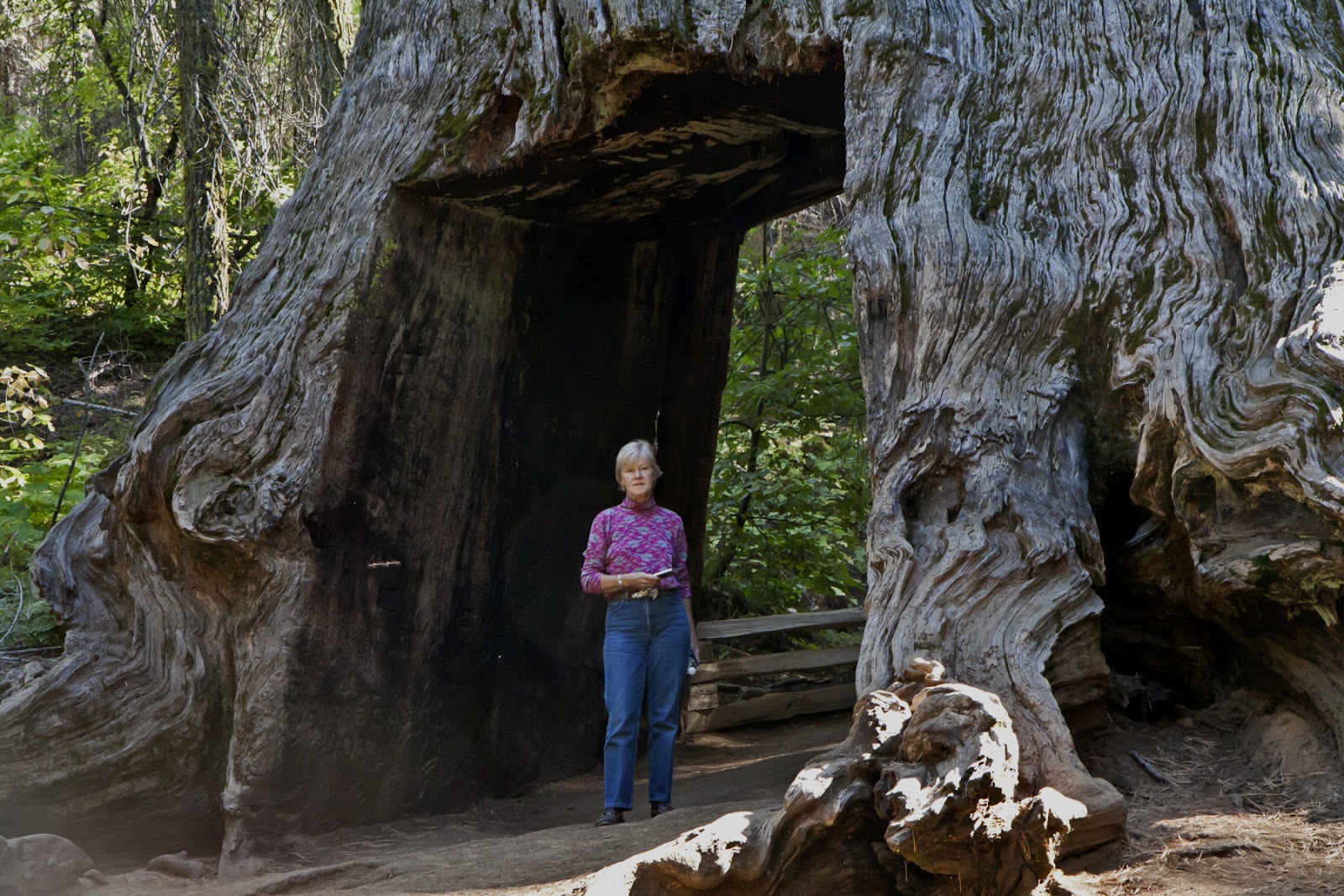
 This is the remains of a sequoia that had a tunnel created thru the base. This is not the only one that we saw while we were visiting Yosemite
 This is another perspective of these large trees. This one is huge when you consider the number of people spread across the base. One of the top limbs on this tree has a diameter of over 7 feet.
Finally, Marty and I posed in front of this setting of 4. One has been named the bachelor and the other 3 were identified as the three graces. There are 3 specific groves where you can see these trees in Yosemite. They are a spectacle.
 One of the large rock formations has been titled El Capitan.  That is what this huge formation is. It is one of the places that the rock climbers enjoy. For some it takes days and if you are very, very good you can climb the 3000 foot elevation in hours. One of the interesting facts is many of the climbers stay on the face of El Capitan overnight. They actually have some type of a bed that they anchor into the side of the rock.
 This is another of the famous rock formations in Yosemite. It rises some 5000 feet above the Yosemite Valley and reaches some 8800 feet above sea level. It is reported that every year thousands of people hike the 16 miles to the summit with a round trip taking from 10 to 12 miles. Marty and I drove to a point where we took this photograph and didn't have to hike far to get here. This is Glacier Point and is accessible by car. We had no interest in hiking to the summit.

Speaking of hiking and mountain climbing. Look at El Capitan again. When I took that photograph, we were in the Yosemite Valley. We were made aware of some climbers going up El Capitan. I zoomed in on the location with my 400mm lens and captured this image. There are two climbers on this small ledge on their way to the top.

There are a number of water falls in Yosemite, but in October 2012, most of them had dried up and there was little or no water falling from them.  Because hiking is one of the more popular things to do, we were told of a hike to the top of Vernal Falls. There is a foot bridge across the water about half way to the falls where we could turn around or if we were adventuresome we could continue to the top.
The round trip to the top of the falls is around 3 miles, you gain over 1000 feet in elevation and should plan to spend at least 3 hours - round trip. It is a steep slope.

We made it - Clint did not bring hiking shoes to Yosemite- so he made the hike in his cowboy boots. It was exhausting, we met some fun people along the way and the scenery was beautiful.

So, if you are planning on going to Yosemite and want to be part of the crowd be sure to take hiking shoes or you will miss a major part of the 750,000 acres.

Yosemite National Park

18 September, 2012

We took a trip to Lovell, Wyoming and visited the Bighorn Canyon. We entered via the southern end of the canyon, as there are several different ways to get there. You may wonder how did it get its name or what makes this place so popular. Most likely, the biggest attraction is fishing on the Bighorn River which attracts alot of fishermen. If you are a horse lover, it is the home of a herd of wild horses.

Although all of these are factors, the canyon most likely got its name from the Bighorn Sheep. This is a family of bighorns that were on top of one of the peaks during our visit.
Of course, we came to see the wild horses, and soon after we entered the canyon, this small herd of horses entered the highway we were on.  They got close to the car and we took lots of pictures of them. However, if you are thinking of wild horses, this tells the story best.
 During this trip, we saw a couple more of the wild horses in this setting. There were actually 2 horses initially and after we had taken several pictures, a black stallion appeared on the scene. He was in a clump of bushes to the right of this horse. This was one of our favorite photo's as it captured the wild horse as well as the landscape of the canyon.
 We could leave the canyon without showing you a picture of some of the rock formations. Supposedly, the entire canyon was the bottom of a lake, most likely millions of years ago and many of these formations were a result of the water and ultimately the erosion from the water.
 We had to add this photo as it most likely represents the picture that most people have in their minds when they think of wild horses in the mountains. Look carefully and you will see a 4th horse in the lower left corner of the picture.
 and how about a close up of one of the horses. It was the zoom lens that made this possible. After you have visited the Bighorn Canyon, and even this picture, you wonder how the horses survive. There is a lot of ground with no grass, there are plenty of rocks, sage brush and other non-appetizing growth. But, somehow they survive.
 Finally, we leave you with a picture of the rocks on top of one of the ridges. There were lots of scenic views, this just being one of them.
We have plans to return to the blog with other photos we took during this trip. Some of which were taken at a horse show at the foothills of the Bighorn Canyon.

07 July, 2012

More young animals

Another trip to Yellowstone National Park after a night before at Chico Hot Springs with our friends Gretchen McBeath and Dick Kane. Gretchen had remarked that this would be her 5th trip to Yellowstone with us and she had never seen a bear. As a side note to those of you who do not know Gretchen and Dick, they are bear lovers and have over 100 stuffed bears that they have collected over the years. In anticipation of the trip, I researched where the bears had been seen in Yellowstone in the last 2 weeks. We arrived in the park just before 7:00 AM in hopes of finding a bear before it got too sunny and too hot. By 8:30 we had driven through mist and fog and had seen no bears. 

I had a couple places I wanted to explore, so we did some backtracking. Soon after we left Tower Junction and headed back toward Mammoth, we saw lots of people and cars along the road. The trip became an immediate success as we saw what the onlookers were seeing. A mama black bear and twin cubs. I have developed 6 of the 75 pictures that I took for the blog.
 This is an early view of the mama and her cubs.
 They obviously were hungry and what they were looking for were grubs, the cubs could have been saying at this time, "mom, what are you finding"
 Mama said, just be patient, these are old trees from the fires many years ago, and I'm sure we'll find something to eat.
 This is just one of the trees where they found grubs. They would dig and eat and dig and eat and dig and eat and then move on to another tree trunk. One of the favorite photographs from the escapade was this cub as it climbed along the top of the tree trunk.

02 July, 2012

Baby robins, growing fast

It started on June 25th. Go back to the prior posting to see what I captured on that day. Since then I have captured more photographs of the babies in the nest and I am amazed at how fast they are growing. But before we share with you their current status, I will report that on the 26th I went to the nest where the older babies were to see if they were acting like they wanted to leave the nest. The next was empty and they were gone. So I spent the next hour looking at all of the places they could have fallen and perhaps not made the trip. No sights of babies. Since then I have seen at least one if not both of them. I can tell by their fact that they do not fly like the adults. And now to the new babies.
The first photograph you saw was the beaks peeking above the nest. Not so in this photograph. I captured 4 of them (there are 5 in the nest). They were waiting for mom to return with some food. I was a couple days later that I got a picture of mom at feeding time with the babies. Compare the images of the babies in these 2 photos and see how much they have developed.
 If you think they are developing or perhaps maturing (i.e.: each day), look what's next. Best case I can only see two or three when I look at the nest. The only time I can see more is when an adult is visiting the nest with food. The reason I say adult is because, I just noticed an adult leaving and another adult arriving with more food. I'm guessing it's mom and pop who are sharing the feeding duties. Just like you saw the black bird in the prior post, the adult robins are bringing grasshoppers to the nest.
 Now here is the surprise. The picture below was taken on July 1st and they are already big enough to get outside the nest. Yes, from the little beaks to the fully feathered ready to fly in only 1 week. I have been to the nest several times today, July 2nd, and they are still all in the next, but based on the experience with the other nest, they will soon be gone.
Stay tuned as I will have at least one more update on their status and anything else I can learn about the maturing of baby robins.

25 June, 2012

Young Robins at the Circle B Bar T

If you have been watching the blog, you are aware that there are robin's on the Circle B Bar T. To date you have observed mature birds as they are found around the ranch and in our trees. There have always been nests, eggs, and babies around the house, but I have never taken the time to capture them before they flew away. That changed when I observed two nests. One which was a pair of young ones who will be flying away very soon.
Here they are, sitting in their nest. The grown ups are still responsible for their food but you can tell by their size, it will not be long before they test their wings.
 This is the same two, they are not as relaxed as in the prior photo. I'm not sure if they are testing their voice boxes, telling the adults that it's time for more food or maybe a stretch just before they take off. It's 25 feet to the ground, so they must be strong before they make their first flight.
I was sitting in the family room, watching television, when I saw a nest under the deck. As I watched there were 4 heads popping up, mouths open and perhaps calling for food. As I watched, an adult would arrive and feed them and fly away. Initially, I thought the adult was the same robin, but when one departed and another arrived, I was able to determine it was pair who where minding the nest. I did want to spook the adults so I used my zoom lens from afar to capture the above image.
 When the adults were away from the nest, I got closer and got these 2, peering out of the next in hopes that they could see more food on the way. You ask, what were they being fed? I'm not sure - - - - but sometimes it was a mouth full and other times it appears like it might have been just enough for one mouth. As I was doing the photography, I was able to find this blackbird, perched on a fence post with something in it's mouth.
 A close observation indicated it was a grasshopper. I have not seen enough blackbirds to control the grasshopper population, but I'm sure whoever is being fed these morsels, they will not starve. Hopefully
I can keep you updated with the maturity of these young robins.